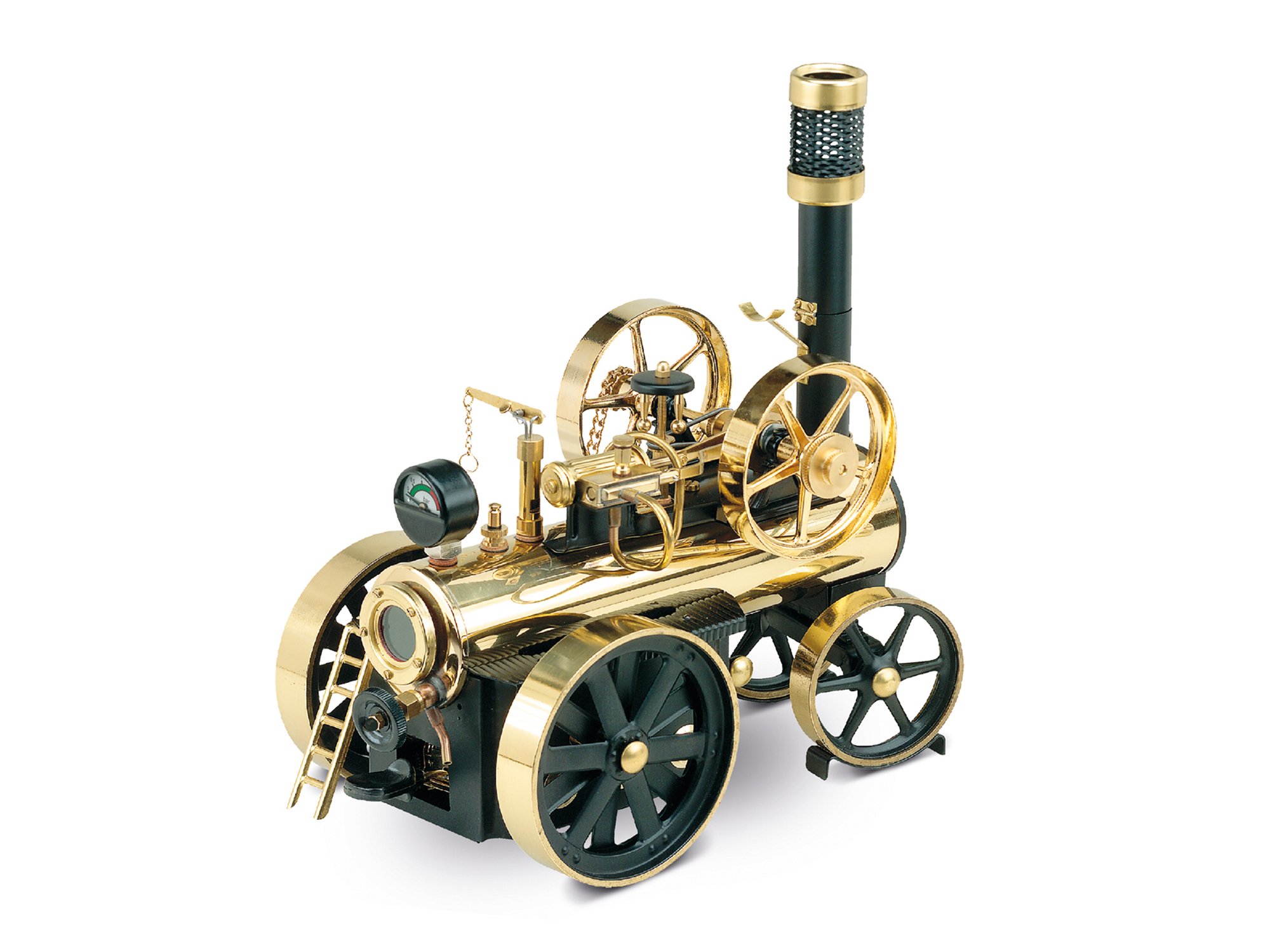
Product information "Rubber Tyre Set for Traction Engines, long profile"
Set of Rubber Tires for Steam Tractors
Steam tractors and steam locomotives typically have wheels made of metal, which are sometimes coated in chrome or brass. This can make the wheels delicate. Hard or rough surfaces can damage the finish.
However, this issue can be addressed by using Wilesco's specially made rubber tires for steam tractors. The rubber tires are easily mounted on the metal wheel rims, protecting the tires from damage and significantly improving traction. Another benefit is reduced noise when driving and a slight cushioning for uneven surfaces.
0 of 0 reviews
Average rating of 0 out of 5 stars
Leave a review!
Share your experiences with other customers.
Login
No reviews found. Share your insights with others.
The Steam-Powered Locomobile D430 by Wilesco
Locomotives were mainly used in agriculture around the turn of the 20th century. They were used for plowing and threshing. At that time, locomotives could be mounted both mobile and stationary. The difference to automobiles was that they were often pulled to their destination by horses. However, they could also drive themselves and move at a speed of 3 - 4 km/h. The details of the steam model D430 correspond to a common locomotive at that time. The brass boiler is 55 mm wide in diameter. It also has a compartmentalized smoke chamber for the condensate. This means that real steam comes out of the chimney, which can also be tilted in the middle by a hinge. The special thing is that the cylinder is double-acting and equipped with two flywheels and a double drive disc.
For the initial steam fun, the D430 comes with two pieces of our dry fuel Witabs to your home. For longer steam fun, make sure to order enough dry fuel!
The exciting history of the locomotive
Locomotives were primarily used by threshers. One could imagine these as a kind of agricultural day laborers. During harvest time, they traveled from farm to farm and offered their services there.
Their locomotives could be mounted both mobile and stationary at that time. The difference to automobiles was that they were often pulled to their destination by horses. However, they could also drive themselves and move at a speed of 3 - 4 km/h. However, operation and power development were only possible while stationary.
For heating the locomotives, low-grade fuel could be used for convenience. Thus, the firebox was even partially heated with straw or cheap wood. The steam engine built up a constant pressure and converted the heat into mechanical energy. The low noise level was particularly advantageous here. At the time, internal combustion engines caused high noise pollution, as the energy was generated as a sequence of explosions.
Locomotives were even used for heavy stationary work until the 1960s, mainly to drive stone crushers or log splitters. After that, they were largely replaced by tractors. These had a more efficient cost-benefit ratio and were easier to operate.
Did you know...
…that the TÜV (Technical Inspection Association) originated from the DÜV (Steam Boiler Inspection Association)?
As steam boilers became more capable of producing more power during industrialization, there were more and more accidents due to exploding boilers. A particularly severe case occurred in 1865 at the Mannheim Stock Brewery. To prevent this, regional "Steam Boiler Inspection Associations" were established, which later became the Technical Inspection Association (TÜV).
Functional cookies are absolutely necessary for the functionality of the web shop. These cookies assign a unique random ID to your browser so that your unhindered shopping experience can be guaranteed over several page views.
Session:
The session cookie stores your shopping data over several page views and is therefore essential for your personal shopping experience.
CSRF token:
The CSRF token cookie contributes to your security. It strengthens the security of forms against unwanted hacker attacks.
Timezone:
The cookie is used to provide the system with the user's current time zone.
Cookie settings:
The cookie is used to store the cookie settings of the site user over several browser sessions.
Cache handling:
The cookie is used to differentiate the cache for different scenarios and page users.
Information on origin:
The cookie stores the referrer and the first page visited by the user for further use.
Activated cookies:
Saves which cookies have already been accepted by the user for the first time.
CAPTCHA integration
PayPal payments
Google Pay payments
Mollie Payment:
This cookie is used to group all events generated from a unique user session across multiple checkout pages.
Cookie-Configuration-Hash
Shopware Analytics ist ein Analysedienst zur Erfassung des Shopping-Verhaltens auf diesem Webshop, bereitgestellt von der shopware AG (Ebbinghoff 10, 48624 Schöppingen, Deutschland) in gemeinsamer Verantwortung (siehe auch die Datenschutzinformationen). Die Rechtsgrundlage für die Datenverarbeitung ist Art. 6 Abs. 1 S. 1 lit. a DSGVO. Sofern Informationen lokal gespeichert werden, entnehmen Sie bitte weitere Details zur Datenverarbeitung unserer Datenschutzerklärung.
Empfänger der Daten ist die shopware AG sowie IT-Dienstleister. Verwendete Technologien umfassen Local Storage. Die erhobenen Daten beinhalten Kundengruppe, besuchte Seiten, Klickpfade, Datum und Uhrzeit des Besuches, Informationen über das genutzte Endgerät (Auflösung, Auflösungsdichte, Betriebssystem), Referrer URL, Informationen des verwendeten Browsers, Gebietsschema, Suchanfragen, Zeitzone. Der Zweck der Datenerhebung dient dem Marketing, der Analyse und der Statistik.
Die Datenverarbeitung erfolgt innerhalb der Europäischen Union. Bei Fragen zum Datenschutz können Sie den Datenschutzbeauftragten unter legal@shopware.com kontaktieren. Weitere Informationen finden Sie auf https://www.shopware.com/de/datenschutz/website.
Gespeicherte Daten:
Shopware Analytics fügt die folgenden Daten zum Local Storage des Browsers hinzu, bis die Zustimmung widerrufen wird: _swa_anonymousId (eine eindeutige Kennung des Besuchers), _swa_userTraits (Benutzermerkmale des Besuchers).
Erweitertes Conversion Tracking
Google Ads
Google Ads
Google Analytics
Marketing cookies are used to display advertisements on the website in a targeted and individualized manner across multiple page views and browser sessions.
Facebook Pixel:
The cookie is used by Facebook to display personalized advertising offers based on user behavior to users of websites that integrate Facebook services.
Google AdSense:
The cookie is used by Google AdSense to promote advertising efficiency on the website.
Google conversion tracking:
The Google Conversion Tracking Cookie is used to track conversions on the website effectively. This information is used by the site operator to target Google AdWords campaigns.
Tracking cookies help the shop operator to collect and evaluate information about the behaviour of users on their website.
Google Analytics:
Google Analytics is used for traffic analysis of the website. Thereby statistics about website activities can be created and read out.
Cookies used for statistics and shop performance metrics.
Google Analytics
Allows Google to collect personal data for online advertising and marketing.
Google Advertising
Brevo:
Brevo tracker
Meta Pixel:
For the placement and optimization of Facebook and Instagram ads, you can agree to the integration of the Meta Pixel in our shop.
Wishlist
YouTube video
Vimeo video
Google Tag Manager
Google Analytics
We respect your privacy
This website uses cookies to ensure you get the best experience on our website... More information.